Venice cholera epidemic
Death in VeniceThe Venice cholera epidemic transforms the city’s tourist calm into a crisis shaped by concealment: infection advances while officials minimize it, and reliable knowledge comes to Aschenbach only after he has begun to welcome the disorder for private reasons. The account connects disease to public-health failures and commercial interests without making the epidemic merely a metaphor; its cases, fatality, institutions, and burial traffic establish a concrete emergency. Against that reality, Aschenbach’s decision to keep silent exposes how his infatuation compromises his judgment and his responsibility to others.
Emergence and Early Signs
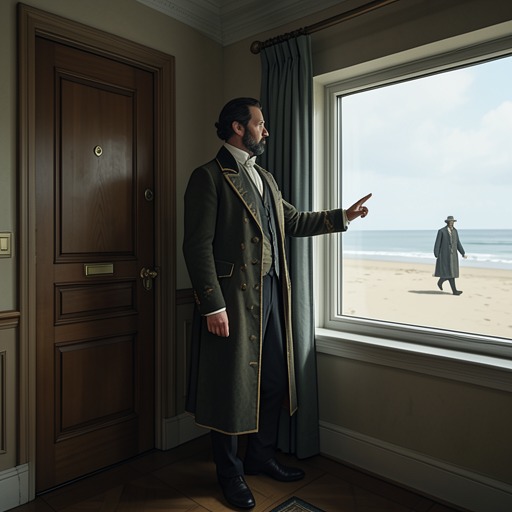
During Aschenbach’s fourth week on the Lido, he notices that the hotel is losing guests rather than gaining them. German speech in particular dwindles from the dining room and beach. A barber mentions that a German family left soon after arriving, then remarks that Aschenbach has no fear of the plague. When Aschenbach presses him, the barber retreats into silence and tries to change the subject. The exchange turns an apparent change in hotel occupancy into an early clue that the outbreak is being discussed obliquely, if at all.
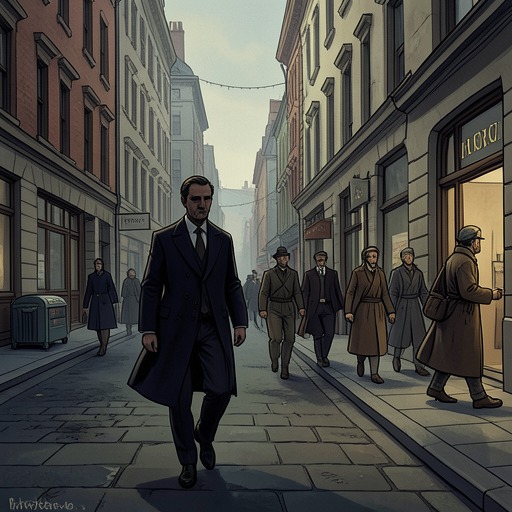
In Venice, the warning signs are present but framed as routine precautions. Municipal posters advise against seasonal gastric illnesses, shellfish, and canal water; their euphemistic tone makes the avoidance of a direct explanation conspicuous. At a shop, an inquiry about the strange smell of disinfectant elicits an assurance that it is only a police precaution against oppressive weather and the sirocco. Aschenbach encounters the disinfectant again on the steamer back to the Lido. The notices and measures are visible, but their meaning is obscured by explanations that encourage visitors to regard them as ordinary safeguards.
The papers compound that uncertainty. The foreign-language press gives Aschenbach no information; domestic reports offer rumours and vague statistics, followed by official denials and doubts about whether the accounts are true. He infers that German and Austrian guests have departed while visitors of other nationalities remain unaware or unconcerned. His anger at the effort to keep the matter quiet is already entangled with a private response: he feels satisfaction at the prospect of disorder because it may help keep Tadzio in Venice. The epidemic is thus introduced at once as a public danger and as knowledge Aschenbach is tempted to use for himself.
Scale and Course of the Outbreak
A British clerk at the English travel bureau finally confirms that the official explanation is incomplete and tells Aschenbach what has happened. Indian cholera has spread from the Ganges delta through Asia and onward to Mediterranean ports. In Venice, the first reported cases appeared in May in a cabin boy and a greengrocer; the cases were kept secret, and further infections followed across several parts of the city. Reports reached German newspapers after a visitor from the Austrian provinces returned home and died with unmistakable symptoms.
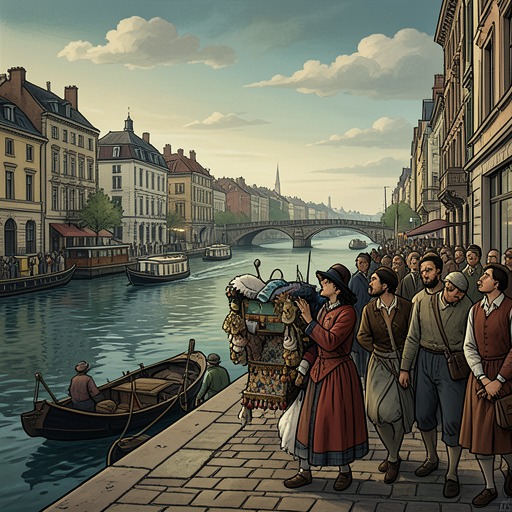
The outbreak worsens under the early summer heat. The account identifies the lukewarm canal water and possible contamination of the food supply as factors in the disease’s spread. Recovery is rare: eighty out of every hundred attacks are said to be fatal. At the beginning of June, the pesthouse at the Ospedale Civico is full, the two orphan asylums have little room left, and bodies are being carried in a steady traffic from the Fondamenta Nuove to the burial island of San Michele. These details give the epidemic an institutional and geographic scale: it strains care facilities and makes the city’s ordinary routes part of the handling of death.
The information available to the public remains contradictory even as the crisis deepens. In local cafés, Aschenbach finds reports that put the number of sick and dead at twenty, forty, or more than a hundred, followed by outright denials or claims that cases are isolated and imported. Warnings and protests circulate, but certainty remains impossible. The pattern is not a simple absence of information: it is a clash between evidence of spreading disease and public statements that repeatedly qualify, disavow, or redirect it.
Concealment and Commercial Interests
The English clerk explains why the authorities persist in silence. They fear that panic and adverse publicity will damage prosperity, including the recently opened art exhibit in the public gardens, the hotels, and the broader business built around foreign visitors. The account presents the city’s policy as an explicit choice: commercial losses and the tourism system outweigh truth-telling and respect for international agreements. The chief health officer resigns in protest and is replaced by someone more compliant, a personnel change that makes the suppression of the outbreak an institutional practice rather than a single evasive answer.
That policy operates through several levels of denial. The barber deflects Aschenbach’s questions; the shopkeeper describes disinfectant as a precaution; the hotel manager attributes it to exceptional heat and a police regulation. The manager’s explanation is notably amiable and solicitous, but its reassuring manner does not make it reliable. In the press, official denials accompany hazy statistics. Taken together, the scenes show how the outbreak is managed not only through public announcements but also through everyday interactions in tourist spaces, where visitors are offered plausible explanations that obscure the underlying threat.
The secrecy carries social consequences beyond the risk of infection. The account describes growing insecurity and demoralization among the lower classes, with more drunkenness, unsafe streets, burglaries, and murders; some people believed to have died of cholera are found to have been poisoned by relatives. It also records an abnormal expansion of professional debauchery. These developments are presented amid the disorder produced by the epidemic and the authorities’ conduct, not as a replacement for the medical crisis: disease, uncertainty, and official corruption together unsettle the city’s social order.
Aschenbach’s Knowledge and Choice
Before he obtains a full account, Aschenbach searches local papers and asks questions partly to force those who know the truth to lie to him. The evasions give him a grotesque sense of participation in a secret from which he is otherwise excluded. When the English clerk speaks plainly, Aschenbach briefly imagines warning Tadzio’s mother and urging her to leave with her daughters. He recognizes that this would be the responsible course, yet does not carry it out. Prudence and the prospect of returning disgust him, while the city’s disorder feeds hopes connected to his infatuation.
Aschenbach’s choice is stated plainly: he keeps silent and remains in Venice. His silence does not cause the epidemic, but it makes him complicit in withholding a warning from a family whose continued presence matters to him. The outbreak therefore exposes a specific moral reversal: a danger that should prompt departure becomes, for him, a condition he privately welcomes because it may prevent Tadzio from leaving. His knowledge increases, but it does not lead to responsible action.
Afterward, the truth appears to spread despite the reticence of those with interests in concealing it. Foreign guests flee, bathing houses stand empty, and the dining room grows sparse. The woman with the pearls and her family remain, whether because rumours have not reached them or because they are unwilling to heed them; Tadzio remains too. This late contrast between the departing visitors and the family still at the hotel preserves the immediate stakes of Aschenbach’s silence. The Venice cholera epidemic is at once a public-health catastrophe and the pressure that reveals how far his private desire has displaced caution, truth, and concern for others.